
The Spicy Wave Hits San Francisco Part Two: Air Guitar Unhinged


Four years ago, our friend Jacque came to visit from Chicago. During her stay, she and Kara started talking about a new routine for her air guitar persona, Jessie Spandex.
The character was inspired by caffeine-pill-popping overachiever Jessie Spano—played by Elizabeth Berkley in the '90s teen sitcom Saved by the Bell. Berkley later became famous as Vegas dancer Nomi Malone in the notorious camp classic Showgirls.
By the end of her visit, Jacque had a concept that would fuse both characters into a musical fantasy only air guitar could weave: Saved by the Bell meets Showgirls.
Some air guitar routines stood out by less formal, more fluid standards.
And that was all I knew when Jessie Spandex bounced onstage like Little Red Riding Hood in '90s neon. It wasn't much, but I reminded myself to try and forget it in fairness to the other nominees. Especially with only one of them performing live this year—the woman three feet in front of me holding a cardboard sign that read "Vegas"—I really did want to give an honest answer to the question: "Is this the most Kara?"
Jessie pointed at the sky to signal she was ready. I was trembling with excitement. Still, I could tell something was off as soon as the track started. Not just the body-accents that create the illusion of real guitar-playing (what air guitarists call "technical merit"), but a disconnect between the choreography and emotion. Strum for strum, Jessie was taking us on a journey worthy of Paul Verhoeven's fever dream about a showgirl sticking her head into the wolf's mouth of Las Vegas. Yet her blend of rock goddess and aerobics queen faltered under the weight of a nameless desperation.
Then it hit me, right in the chest: Nameless. That was the point.
An onstage costume change is a big risk in air guitar. A snag between layers of clothing can ruin an otherwise flawless performance. Yet here was Jessie, kicking off shoes, pulling a wig off another wig, and tearing neon-bright fabric off a metallic fringe dress as if nothing, not even the sacred cow of her buoyant image, mattered beyond the completeness that waited just a garment drop away. With each reveal, she peeled away another layer of herself, an emotional surgery exposing a plea for human connection: I'll do whatever it takes to make you love me. If I can't entertain you, then you won't love me. Without your love, there is no me.
Nomi.*
Suddenly, I found myself struggling to breathe—and not from the crowd pressed up against me. Like a shadow play from another dimension, I could see my late wife's spirit spreading her phoenix wings on the wall behind Jessie as she launched into the final moments of her performance. Down on the ground—another competitive risk, dropping the power finish move—she showed us what air guitar could feel like when a heroic pantomime dared to reverse its own narrative: The invisible mirrored our need for love and the conditions we placed on it that made us suffer.
All her life, Kara struggled to love herself. I, too, struggled with this as I lay alone in our queen-size bed.
Without your love, there is no me.
Nomi.
Right on schedule, I turned in my pick for the Sparkling Unicorn Warrior Award. From halftime through the second round, I holed up in the green room again, puzzling over what I would say to 500 people who, for all they knew, had spent the last three hours at a festival of fake rock'n'roll. Why should they care about a posthumous award honoring an air guitarist they didn't know?
Then I reminded myself: Because air guitar is an art as well as a sport. It's a form of self-expression. A love letter to creativity. In the hands of the right performer, air guitar could pull the audience into an operatic dreamworld or strap it to an emotional bottle rocket. Every time Kara stepped onstage, she wrote love letters to creativity like she was skywriting.
There was my answer.

As a sport wrapped around an art form, air guitar challenged artists to excel according to a measurable standard. Yet some air guitarists distinguished themselves by less formal, more fluid standards. The award recognized those who expanded air guitar not as a test of prowess, but as a shared lucid dream. It celebrated artists who whisked audiences into worlds of metaphor with their own laws of creation, their own latitudes of emotional power.
So I had the skeleton of a speech. But how would I translate it–an abstract sent up from my subconscious–into words that were not only intelligible but practical? Without stumbling over grammar, buckling under stage fright, or bursting like a pimple full of overly verbose widower goo?
From the emcee's muffled voice outside, I could tell the second round was over. The time had come for my presentation. Now that I was alone in the small white room–barely more than a walk-in closet–I took a moment to observe myself. The slackness in my muscles suggested I was slipping back into oncology's grasp, hypnotized by the droning of an ER doctor.
Since my wife's death, even welcome forms of pressure triggered a memory so familiar it bordered on archetype: The ER doctor explaining Kara's blood work.
I was about to praise her before hundreds of people. Yet I seemed too loose-limbed, weirdly detached. I was at the mercy of the pharmacist in my brain, nestled in a chemical blanket of numbness. Where was the tingling under the scalp, the thudding in the chest? As if to rub sensation back into myself, I turned toward the trophy beneath the liquor cabinet by the door.
From an interview she gave me three years earlier, something Kara said came back to me: "And the fear and the nerves just disappear. And I'm like, 'This is what I got. And this is what it is.'"
Normally, I would focus on such a memory to push myself through a mental barrier. But coupled with the award beckoning to me, the words made me realize I was far from losing my nerve. I was clear-headed, even comfortable. Intellectually, I'd been fighting my fear of public speaking like I'd locked myself out of my car in the middle of a desert. But from the depths of my intuition, I understood my "keys" had been with me all along.
Not only that, but they were all around me. I could conjure them at will. No one placed any conditions on them but me. Love was the original key, as cliché as it sounded. The moment I trusted in this, I could unlock my thoughts from a feeling of abundance.
"This is what I got. And this is what it is."
Cradling the trophy and certificate in the crook of my arm, I went out to the main floor. I took my place in the wings. Seconds later, on cue, I entered from stage right. Hypes, the emcee, walked toward me. The microphone seemed to levitate into my hand. Without thinking, I moved toward the front of the stage and opened my mouth. My voice filled the room with a clarity and fullness I'd never heard before.
For the next three minutes, the invisible mirrored our need for love–only this time free of the conditions that make it painful. Why had I tortured myself over the loss of my "keys?" They were everywhere. In the sea of dimly lit faces. The stage lights' glare. The music of the crowd chanting Kara's name. Next thing I knew, "This is what I got" reached a crescendo and my voice fell silent under the swelling of applause.
And somehow the trophy floated into the hands of this year's winner: An artist who shattered me emotionally with an air guitar routine inspired by a movie like Showgirls.
How ridiculous. How unhinged.
How Kara.

*For more about identity in Showgirls, see Adam Nayman's in-depth film study, It Doesn't Suck: Showgirls (ECW Press, 2018).
This concludes Part 2 of The Spicy Wave Hits San Francisco
--Charles Austin Muir
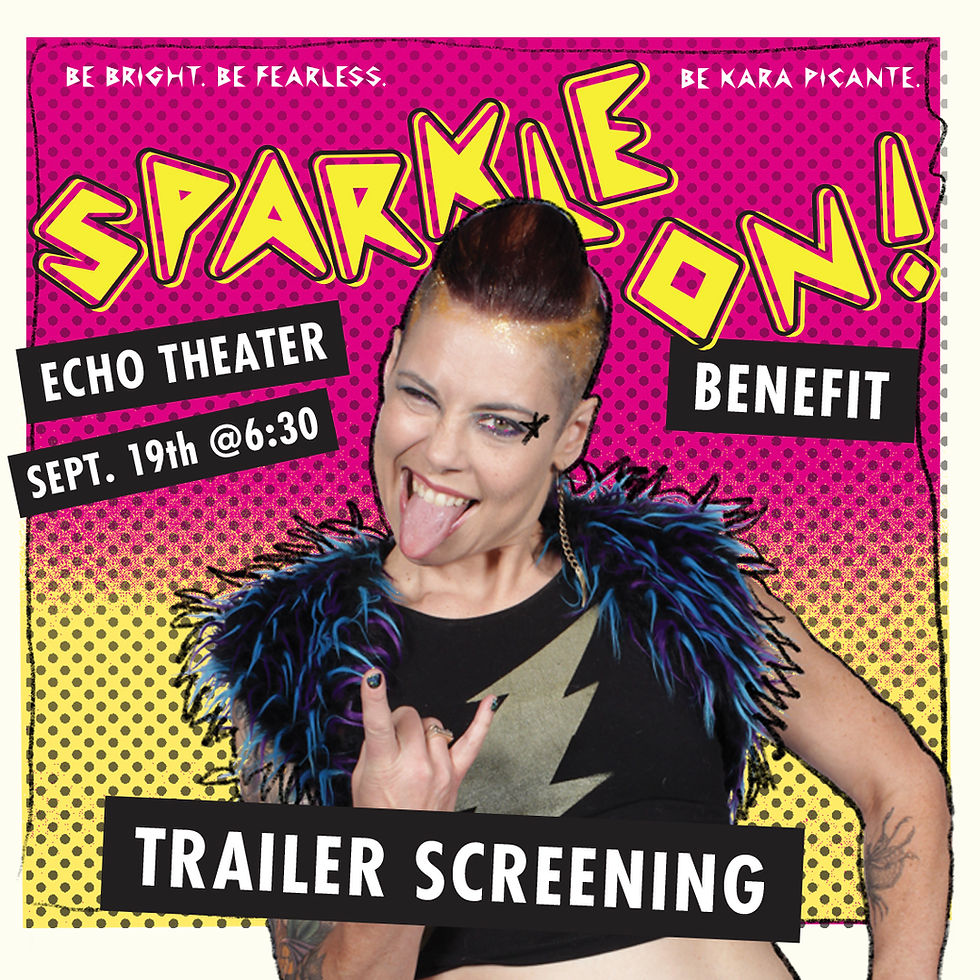
Please forgive the icky YouTube title, it's all about clickability these days. If you haven't seen the teaser trailer for Kara's award yet, here you go!
Comments